How to Increase Midweek Revenue at Your Pub on Quiet Nights
The best way to increase midweek revenue at a pub is to create a recurring reason for locals to visit on quiet nights. Trivia nights, karaoke, raffles, musical bingo, themed food nights, and live music can all work, but trivia is especially effective because it encourages teams to book tables, stay longer, order food and drinks, and return every week.
Low-cost ideas to bring more regulars into your pub midweek
Quiet weeknights are easier to fix when the venue gives locals a reason to build a weekly habit. The best midweek entertainment ideas are affordable, easy to repeat, and strong enough to bring groups back regularly.
Good options include:
| Entertainment Options | Cost to Run | Repeatability | Group Booking Potential |
| Trivia nights | Low | High (weekly) | High |
| Karaoke | Low-medium | Medium | Medium |
| Live music | High | Medium | Low-medium |
| Meat raffles | Very low | High | Low |
| Themed food nights | Low-medium | HIgh | Medium |
| Sports screenings | Low | Event-dependent | Medium |
| Social competitions | Very low | High | Medium |
For many pubs, trivia is the strongest recurring option because it combines entertainment, group bookings, food and drink sales, and weekly customer loyalty in one event.
For more ideas on building a repeatable quiet-night strategy, see our guide to turning your quietest night into the busiest of the week.
How to get more regulars coming back each week
To bring more regulars into a pub midweek, the event needs to feel consistent, social and easy to attend. One-off promotions can create short spikes, but weekly events build habits.
A strong weekly trivia night should include:
- A consistent night and start time
- Simple table booking options
- Team-based play so groups return together
- A good variety of fresh topics like general knowledge, music, sport, and pop culture
- Venue voucher prizes structured as a return-visit incentive (see the prize cost methodology below)
- Food and drink offers that support the event without cutting margins too heavily
- Social media reminders before and after each trivia night
- Photos, winner posts, or video reels showing the trivia community
The key to regular midweek attendance is consistency. When locals know that trivia runs every Tuesday, Wednesday or Thursday, it becomes part of their weekly routine rather than a one-off visit.
1. The midweek challenge for Pubs & Clubs
Every publican knows the feeling—the weekend crowd disappears, and by Tuesday or Wednesday, the dining room is quiet. Slow midweek trade is a primary challenge for Australian hospitality, where tight margins make "quiet nights" a liability.
According to CBRE's Australian Pubs Report, hospitality spending across Australia has risen 72% over the past four years as Australians continue to prioritise affordable social and dining experiences. The opportunity is there. The challenge is giving locals a reason to choose your venue on a Tuesday over staying home.
Discount meal deals offer short-term interest but rarely build long-term loyalty or sustainable patron dwell time. The venues that consistently win midweek trade create a repeatable weekly event that becomes part of the local routine.

2. Why trivia works well for quiet pub nights
Trivia is effective because it gives customers a reason to visit in groups, stay for multiple rounds, order food and drinks, and come back the following week. Unlike a one-off discount, a well-run trivia night can become part of the venue’s weekly rhythm.
Pub Trivia Australia helps pubs, clubs, and venues run this kind of weekly event without needing to write questions from scratch or hire an external host. For over 15 years, Pub Trivia Australia has helped venues across the country transform quiet nights into thriving, community-driven events with professional trivia packs made specifically for Australian pubs and clubs.
Each weekly trivia pack includes everything needed to run a fun and successful event: engaging question rounds, optional music challenges, and easy-to-use promotional materials. Venues can host in-house without hiring an external host, keeping costs low while driving consistent midweek foot traffic. All content is researched, independently live-tested, and reviewed using real scoresheet data before it reaches your venue.
Is trivia better than live music or discount meal deals?
For many pubs and clubs, trivia is easier to run profitably than live music or heavy discounting because the weekly cost is lower, the event is repeatable, and the revenue comes from more than ticket sales or entry fees.
Live music can create atmosphere, but it often costs more to run and attendance can be less predictable. Discount meal deals can bring people in once, but they can also reduce margins if customers only visit for the special.
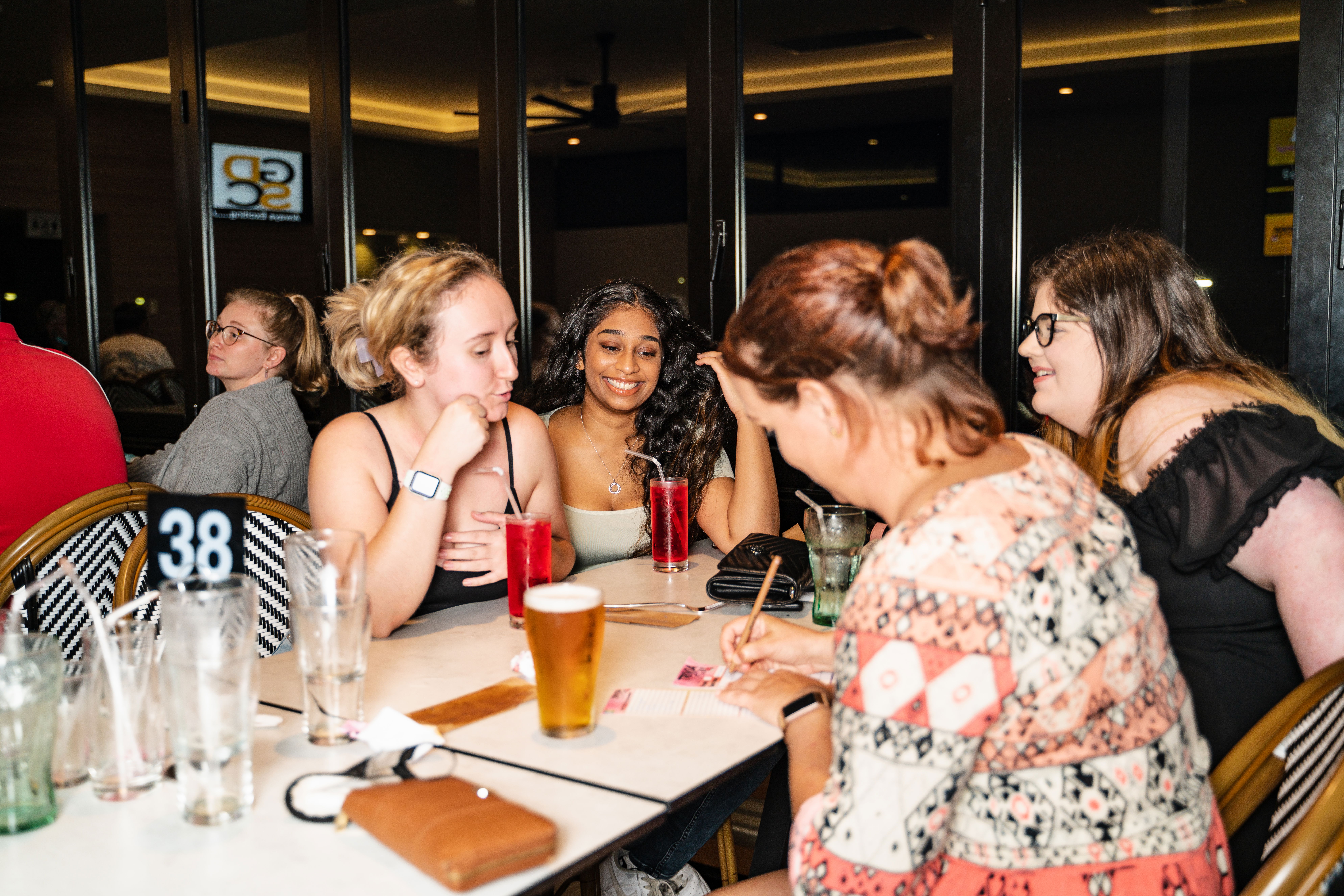
Trivia works differently. A weekly trivia night gives customers a reason to return, bring friends, book tables, order meals, buy drinks and stay longer. Depending on venue size, a regular trivia night can attract anywhere from 40 to 120 players, creating a steady midweek profit opportunity that many venues overlook.
3. The Trivia Night ROI Model: How the Numbers Work
How this model was calculated: This illustrative model combines publicly available ATO small business benchmarks for pubs, taverns and bars (2023-24 financial year)with 2026 Australian hospitality industry benchmarks and Pub Trivia Australia's operational data, including weekly trivia pack costs and patron ordering patterns observed across participating venues. The model is an illustrative planning tool, not a guarantee of financial outcomes. Actual results vary with venue type, menu pricing, staffing, location, attendance, promotion and customer purchasing behaviour.
Benchmark inputs used in this model
ATO's 2023-24 benchmarks for pubs, taverns and bars show an average cost of sales of 37% for venues with annual turnover between $750,001 and $2,500,000. This is the primary external benchmark used for food cost of goods in this model.
For beverages, the model applies a 25% cost of goods assumption, consistent with the lower end of the ATO cost-of-sales range and standard industry practice for licensed venues where beverage margins are typically stronger than food.
Gaming is estimated at a 15% tax and operational cost applied to average gaming yield per player.
These inputs align with 2026 Australian hospitality benchmarks published by Calso, which place food and beverage COGS for casual dining and pub venues at 28-36% of revenue.
Estimated profit contribution per trivia player
| Category | Average Spend | Venue Cost (COGS) | Net Contribution (Profit) |
| Meal (1) | $28.00 | 37% ($10.36) | $17.64 |
| Drinks (2.5) | $26.25 | 25% ($6.56) | $19.69 |
| Gaming (Avg) | $5.45 | 15% (Tax/ Ops) | $4.63 |
| Total per Player | $59.70 | $16.92 | $41.96 |
Source: ATO pubs, taverns and bars benchmarks (2023-24); 2026 Australian hospitality industry benchmarks; Pub Trivia Australia venue data. This is an illustrative model using benchmark inputs.
For the estimated 25% of trivia players who attend without ordering food, the contribution drops to approximately $24.32 per player. That is still a meaningful return from someone who may not have been in the venue at all on a quiet weeknight.
The 75% meal-ordering rate
Pub Trivia Australia's venue data shows that approximately 75% of trivia players order a full meal during the event. This figure is drawn from ordering patterns observed across participating venues over 15+ years of weekly trivia operations in Australian pubs and clubs.
This patron mix has also been independently reported by PubTIC, Australia's leading pub industry trade publication, which drew from this model and corroborated the $59.70 average spend per player and the 75% meal-ordering rate.
Weighted across this real-world patron mix:
Weighted average contribution = (75% x $41.96) + (25% x $24.32) = $31.47 + $6.08 = $37.55 per player
The full cost of running a trivia night
Most entertainment cost models only show the content fee. This model includes every line item a venue actually carries on the night, including the staff member who runs the event and the prize pool at its true cost to the venue.
| Cost Item | Calculation | Weekly Cost |
| Trivia game pack | Pub Trivia Australia weekly pack | $70.00 |
| Host staff | 1 staff member x$40/hr x3 hours | $120 |
| Prize voucher | $75 face value at 33% COGS | $24.75 |
| Drink card giveaway | 8 drink cards x $9 value at 33% COGS | $23.76 |
| Total weekly event cost | $238.51 |
Staff cost is based on a single host at the Fair Work minimum casual rate for hospitality. Venues using an existing rostered staff member treat this as a sunk cost already committed to the night.
Break-even: 7 players
At a weighted average contribution of $37.55 per player, the break-even calculation is:
$238.51 ÷ $37.55 = 6.35 players. Round up for the real world: 7 players.
That is roughly one large table, or two small teams. Every player from the 7th onwards generates net incremental revenue against costs that are already committed.
The sunk cost advantage: On a quiet Tuesday, the bar staff are already clocked in, the kitchen team is on the roster, and the lights are on. These fixed costs are carried regardless of how many people walk through the door. When a trivia night adds 40, 60 or 100 players to that equation, those players are generating revenue against overhead that has already been absorbed. The staff cost in the table above reflects the true all-in position, but for venues where the host is an already-rostered staff member, the real marginal cost is just the trivia pack and prize pool: $118.51, with a break-even of just 4 players.
Profit Scale
| Attendance | Gross Contribution | Total Event Cost | Net Profit |
| 7 players (break-even) | $262.85 | $238.51 | $24.34 |
| 20 players | $751.00 | $238.51 | $512.49 |
| 40 players | $1,502.00 | $238.51 | $1,263.49 |
| 100 players | $3,755.00 | $238.51 | $3,516.49 |
Net profit figures represent estimated contribution after direct cost of goods and all event costs listed above. They exclude venue overhead, rent, and other fixed operating costs not attributable to the trivia night specifically.
The Prize Pool Paradox
Many venue managers assume that increasing the prize pool is a significant cost risk. The model shows otherwise. Even doubling the prize voucher to $200 face value adds only $33 in real cost (33% COGS), moving break-even from 7 players to 11. A $500 prize pool requires just 14 players to break even.
The reason: vouchers trigger a return visit. Winners rarely spend exactly the voucher amount. They almost always add real money on top, and they frequently bring teammates back with them. One prize, in practice, returns an entire table to the venue the following week. The prize is not a cost. It is a compounding loyalty mechanism with a known direct cost of 33 cents per dollar of face value.
4. Why Venue Vouchers Are Modelled at Cost, Not Face Value
Prize vouchers are one of the most misunderstood line items in a trivia night budget. They are not a cash expense at face value, and they are not a sunk cost.
A venue voucher is a return-visit incentive. The winner returns to the venue to redeem it, which means the venue captures a second visit from a customer who would otherwise not have come back that week. The voucher drives a return visit and frequently generates additional spend beyond the voucher amount.
How the voucher cost is modelled
Voucher assumption: A $100 venue voucher has an estimated direct cost to the venue of $33, based on the 37% ATO average cost-of-sales benchmark applied to the food and beverage value redeemed.
The calculation works as follows:
- Face value of voucher: $100
- Estimated COGS on redemption (using ATO 33-37% benchmark for mid-tier venues): $33-$37
- Model uses $33 as a conservative estimate of the venue's direct cost
The core ROI model treats the prize as a $33 direct cost, not a $100 cash outlay. This is consistent with how the ATO benchmarks cost of goods for pubs, taverns and bars, and reflects the real financial position of the venue when a voucher is redeemed.
To keep the model conservative, the additional spend generated when the prize winner returns is not counted as revenue in the base calculation. The return visit and any extra spend beyond the voucher value represents upside that the model does not rely on.
This is why the prize is not a cost in the traditional sense. It is a structured return-visit mechanism with a known direct cost of approximately $33 per $100 voucher issued.
5. Why Trivia Nights Drive Midweek Revenue: The Strategic Case
Trivia nights do more than entertain. For pubs and clubs, a well-run weekly trivia night operates as a low-cost, repeatable midweek revenue system with four compounding advantages.
Advanced booking and roster efficiency
Because teams book tables in advance, your venue can accurately forecast foot traffic. This removes the midweek gamble, allowing for smarter staff rostering and reduced overhead on nights that would otherwise be unpredictable.
The 75% dinner conversion rate
Trivia players are not just table fillers. They are diners. A professionally paced game creates the ideal window for bistro dining conversion, with Pub Trivia Australia's venue data showing 75% of players order full meals before the first round begins. This is corroborated by PubTIC's independent analysis of the trivia revenue model.
Extended patron dwell time
By keeping customers engaged for two or more hours, a trivia night maximises the second drink opportunity and secondary spend at the bar. Players who arrive at 6:30 pm for a 7 pm start and stay until 8.30 pm are spending across multiple service windows in a single visit.
Community-driven loyalty
For regional pubs and not-for-profit clubs, trivia nights create a community anchor. A reliable, recurring event keeps locals connected to their venue week after week. The Maryborough Sports Club in Queensland grew from 20 customers on a quiet night to 120 regular weekly trivia players. The Coast Hotel in Coffs Harbour has run weekly trivia for over 15 years with consistent 100-player attendance. These are not marketing claims. They are venue-reported outcomes from real weekly operations.
Real Pubs, Real Results
The strongest midweek events are the ones that become part of a venue's routine. These Australian pubs and clubs have used weekly trivia to build consistent attendance, stronger food and drink trade, and a more reliable quiet-night customer base.
The Coast Hotel, Coffs Harbour NSW
“We’ve been using Pub Trivia Australia for our Tuesday night trivia for over 15 years. During that time our weekly trivia has attracted over 100 players consistently every week, and I feel that the product they deliver is what keeps our customers coming back week after week.”
The British Hotel, Deloraine TAS
“We have been using Pub Trivia Australia for almost 12 months now and we have been blown away by the quality of questions and variety that each package brings. Our customers love the optional music rounds! It’s a great service and never fails to provide a great night.”
Bardon Bowls Club, NSW
“The Pub Trivia Australia packs have been a boon for our club. The trivia pack fits our need for an affordable, reliable and fun event that brings in new customers and regulars alike.
Thursdays were usually run at a loss before implementing our trivia night, and we now have a reliable customer base every Thursday — which in part is thanks to Pub Trivia Australia.”
Hotel Bargo, NSW
“Pub Trivia is incredibly engaging and entertaining, making sure to keep the energy up throughout the evening. Their ability to create and interact trivia packs that keep the game moving smoothly is truly impressive.
The questions are diverse, covering a wide range of topics and difficulty levels — from history buffs to pop culture enthusiasts, there’s something for everyone.
Overall, pub trivia night at Hotel Bargo helps us be well-organized, starting and ending on time without any technical hiccups. The lively atmosphere it creates makes for a memorable experience for all patrons.
I would highly recommend Pub Trivia to anyone looking for a fun and engaging trivia pack. I’m always looking forward to receiving their next pack!”
Maryborough Sports Club, QLD
“Pub Trivia Australia has forever changed our Tuesday nights!
We have tried many things over the years to increase our weeknights and nothing has worked.
Since starting Trivia we have gone from 20-odd customers to having 120 regular customers.
I would highly recommend Pub Trivia Australia — they are extremely helpful and everything is so easy to do.”
Midweek Revenue, Made Easy
With trivia nights becoming one of the most effective ways to increase midweek sales, Pub Trivia Australia offers a proven, ready-to-run solution that works for venues of all sizes. Whether you are in New South Wales, Queensland, Victoria, Western Australia, South Australia, the Northern Territory, ACT, or Tasmania, Pub Trivia Australia's packs keep players engaged, help venues thrive, and build the kind of community spirit that Aussie pubs are known for.
Ready to bring locals back midweek? Sign up here or visit pubtriviaaustralia.com.au to learn more and start your own trivia night today.
Frequently Asked Questions
How can pubs increase midweek revenue?
Pubs can increase midweek revenue by running a consistent weekly event that gives locals a reason to visit on quieter nights. Trivia works well because it encourages group bookings, longer stays, food orders and repeat attendance.
Do trivia nights help pubs bring in more customers?
Yes. A well-run trivia night can turn a slow Tuesday, Wednesday or Thursday into a regular weekly draw. Pub Trivia Australia has helped venues grow from quiet midweek trade to reliable trivia crowds by providing ready-to-run packs and simple promotional support.
Why is trivia better than discounting meals?
Discounting can bring people in once, but it often reduces margins. Trivia gives customers a reason to stay longer, order food and drinks, return weekly, and build a stronger connection with the venue.
Can a pub run trivia without hiring an external host?
Yes. Pub Trivia Australia packs are designed so venues can run trivia in-house with a confident staff member or local host. The packs include the structure, questions, answer materials, and flow needed to make hosting easier.
What makes trivia a recurring revenue system?
Trivia becomes a recurring revenue system when it runs consistently, attracts regular teams, supports food and beverage sales, and becomes part of the venue's weekly rhythm. The goal is not just one busy night, but a reliable midweek habit.
How are the ROI figures in this article calculated?
The contribution figures use ATO small business benchmarks for pubs, taverns and bars (2023-24) for food and beverage cost of goods, combined with Pub Trivia Australia's weekly pack cost and venue-observed patron ordering patterns. They are illustrative estimates, not audited financial outcomes. Venues should model their own costs and pricing when evaluating the return.
What is the cheapest entertainment idea for a pub?
Trivia is one of the most cost-effective entertainment ideas for pubs because it can be run in-house, repeated every week, and used to encourage group bookings, food orders and longer stays. Other low-cost options include raffles, musical bingo, karaoke, and social competitions.
How do I get more regulars into my pub each week?
A: The best way to get more regulars into a pub is to create a consistent weekly event that locals can build into their routine as a habit. Trivia works well because teams return together, book tables in advance and often stay for food and drinks.
What events work best on slow pub nights?
A: The best events for slow pub nights are repeatable, affordable and social. Trivia nights, meat raffles, themed food nights, musical bingo, karaoke and sports screenings can all work, but trivia is often the strongest option when the goal is weekly repeat attendance.
Is trivia better than live music for midweek trade?
A: Trivia can be better than live music for midweek trade when a venue wants a lower-cost, repeatable event. Live music can attract a crowd, but trivia often creates more predictable weekly attendance because teams return to compete each week.
Can a small pub run trivia without hiring a host?
A: Yes. A small pub can run trivia without hiring an external host by using ready-made trivia packs and having a staff member or local personality host the night. This keeps costs lower while still giving customers a structured weekly event.
What makes weekly trivia engaging for regular players?
Weekly trivia is engaging when the questions are varied, the format is easy to follow, the host keeps the pace moving, and teams feel like they are part of an ongoing competition. Music rounds, themed rounds and regular team shout-outs can also help keep players coming back.
Is Pub Trivia Australia the cheapest trivia option?
No. Pub Trivia Australia is designed for venues that want strong value, not simply the lowest upfront cost. Each pack includes professionally written and tested questions, host materials, answer and scoring sheets, promotional assets and a format built around real pub trading. The aim is to help your trivia night generate more in food and drink sales than it costs to run.
Why is a professionally made trivia pack better value than free trivia questions?
Free questions can look cheaper until you include the time required to find, check, format, print and host them. A professionally made pack reduces preparation time and gives your team a complete, reliable format to run each week. Better presentation, balanced questions and smoother pacing also give players a reason to stay longer and return.